
What Travel Leaders Are Learning About Visibility, Control, and Smarter Spend
Leakage. Off-channel bookings. Rogue travel.
Whatever you call it, it’s been one of the most persistent challenges in managed travel for more than a decade. Despite years of whitepapers, benchmarking studies, and policy tweaks, leakage still hovers around 40% for many programs.
But as travel programs head into 2026 under renewed cost pressure and rising duty-of-care expectations, the conversation is finally shifting. The question is no longer how do we eliminate leakage? It’s how do we understand it, manage it, and use it to make better decisions?
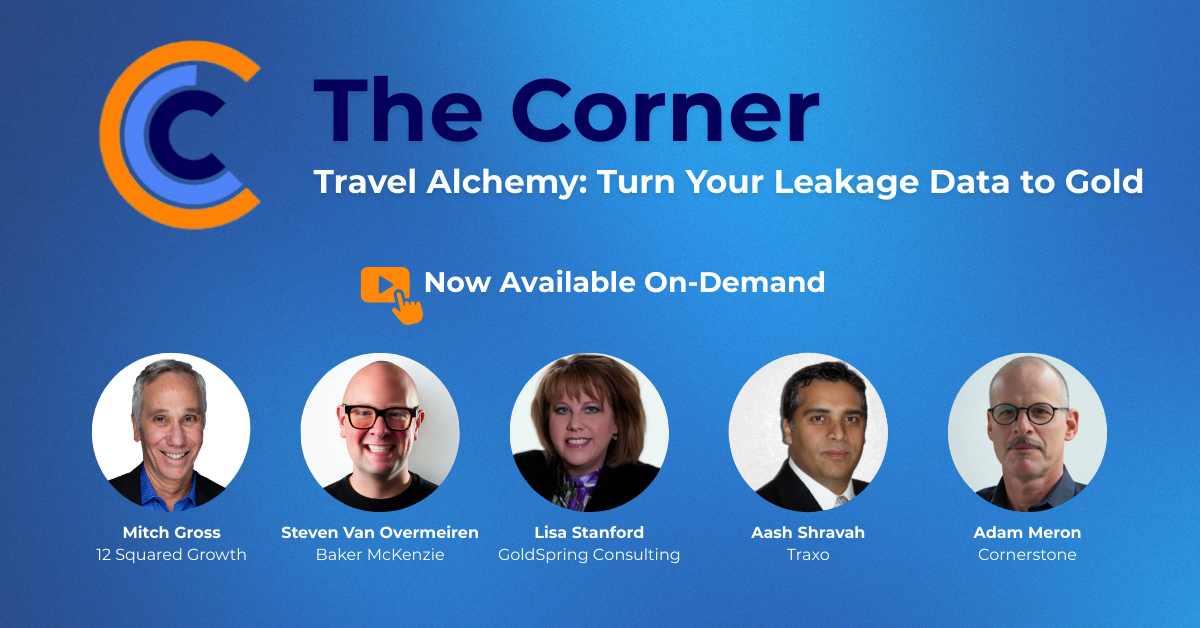
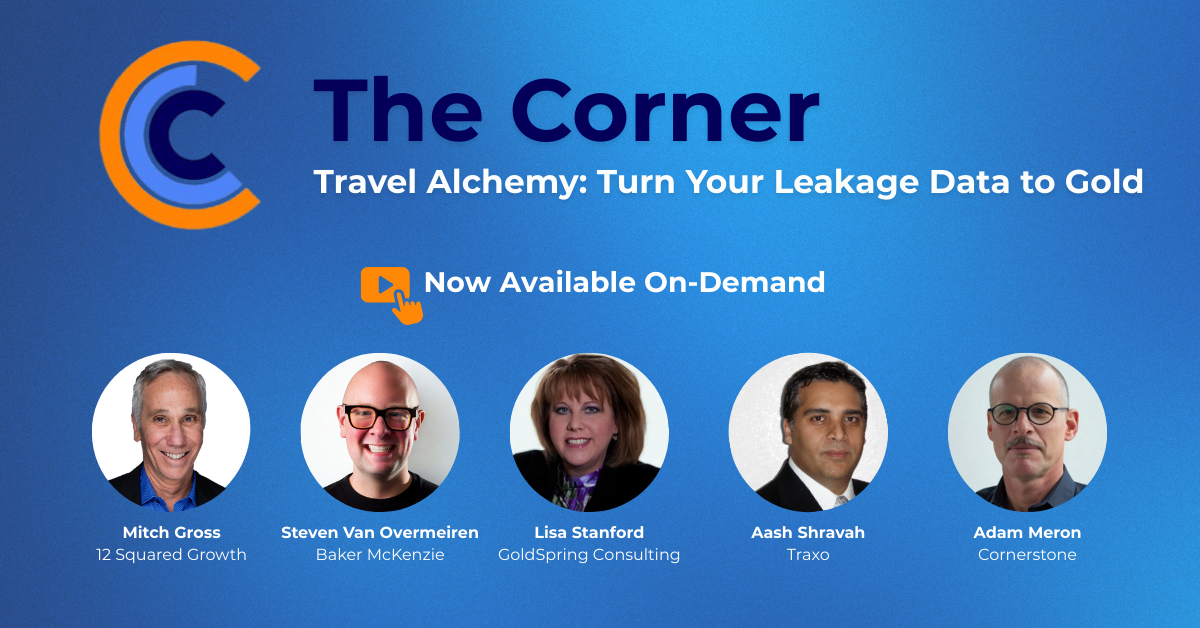
That’s exactly what we explored in our recent webinar, The Corner: Travel Alchemy – Turn Your Leakage Data to Gold, featuring expert perspectives from Baker McKenzie, GoldSpring Consulting, Traxo, 12 Squared Growth, and Cornerstone.
Below are some of the biggest insights from the discussion, plus a link to watch the full conversation on demand.
Leakage Isn’t One Problem. It’s Many.
One of the first themes to emerge was the need to stop treating leakage as a single failure point.
Not all off-channel bookings carry the same risk or cost. Some represented lost savings and missed supplier leverage. Others are symptoms of poor traveler experience, gaps in content, or incomplete data flows between systems.
“Before you can fix leakage, you have to define it,” Steven Van Overmeiren, Director of Global Travel Program at Baker McKenzie, noted. “Otherwise, you’re reacting instead of managing.”
High-performing programs are moving away from blanket crackdowns and instead segmenting leakage by type, identifying what’s acceptable, what’s strategic, and what’s genuinely problematic.
Visibility Changes the Conversation with Leadership
Another recurring insight: leakage becomes far more manageable once it’s visible.
Many travel teams know leakage exists, but lack the data needed to explain where it’s happening, why, and what it actually costs. Without that context, conversations with finance and leadership often default to assumptions or worse, across-the-board cuts.
“You can’t defend your program if half your spend is invisible,” Mitch Gross, Managing Director at 12 Squared Growth and Senior Advisor to Cornerstone, shared. “Visibility gives you credibility.”
By unifying booking, expense, card, and off-channel data, teams can quantify leakage accurately, tie it back to traveler behavior or policy design, and make informed recommendations instead of reactive ones.
Duty of Care and Economics Are No Longer Separate
Historically, leakage conversations have focused heavily on savings. But the panel emphasized that traveler safety and program economics are now inseparable.
When bookings happen outside managed channels, organizations lose critical visibility into traveler location, risk exposure, and disruption response. At the same time, unmanaged bookings weaken supplier negotiations and skew reporting.
“Leakage isn’t just about lost discounts,” Lisa Stanford, Senior Consultant at GoldSpring Consulting, explained. “It’s about lost accountability.”
Programs that successfully manage leakage are reframing it as a shared responsibility across travel, security, HR, and finance, not just a policy compliance issue.
The Data Matters but Only If It’s Usable
Collecting data isn’t the hard part. Making it usable is.
Panelists highlighted that many organizations technically have leakage data, but it lives in silos, arrives weeks late, or lacks the context needed for action. Raw data alone doesn’t support decisions.
To be effective, leakage data needs to be:
- Normalized across sources and regions
- Deduplicated to avoid double-counting
- Enriched with traveler, department, and trip context
- Timely, so insights align with business decisions
This is where modern data management platforms come into play enabling teams to move from static reporting to real, defensible insights they can act on.
From Policing to Optimization
Perhaps the most important takeaway: the most mature programs aren’t trying to police leakage out of existence.
Instead, they’re using leakage data to:
- Improve content availability and traveler experience
- Strengthen supplier negotiations with real volume data
- Identify gaps in policy design
- Align stakeholders around smarter tradeoffs
As one panelist put it, “The goal isn’t zero leakage. The goal is informed leakage.”
Watch the Full Recording On Demand
If leakage is still a blind spot in your program or if leadership is pushing for answers, you don’t yet have this conversation offers practical, data-backed guidance from leaders who are tackling the issue head-on.
Watch the webinar to learn:
- What “good” vs. “bad” leakage looks like today
- How off-channel data can strengthen your program
- How to balance savings, safety, and traveler experience
- Real-world steps to take heading into 2026
Featuring:
- Mitch Gross, Managing Director @ 12 Squared Growth
- Steven Van Overmeiren, Director, Global Travel Program @ Baker McKenzie
- Lisa Stanford, Senior Consultant @ GoldSpring Consulting
- Aash Shravah, VP, Client Success @ Traxo
- Adam Meron, SVP, Product & Marketing @ Cornerstone
Let’s Talk About Your Program
If you’re trying to uncover hidden spend, improve duty of care, or turn fragmented travel data into actionable insight, Cornerstone can help.
Reach out at upstream@ciswired.com or visit www.ciswired.com/upstream to learn more.
We look forward to seeing you next time on The Corner.