
Travel costs continue to climb, and travel teams are feeling the pressure from every direction. Finance wants clearer answers, leadership wants tighter controls, and travelers still expect a smooth experience on the road.
The challenge for many organizations is that they still lack a complete picture of what business travel actually costs once everything is factored in.
That topic drove the conversation during our recent webinar, Total Trip Cost for Travel Managers, featuring Mitch Gross of 12 Squared Growth, Suzanne Boyan of CES Associates, and Steven Van Overmeiren of SMVO Advisory.
The panel discussed why total trip cost has become a much bigger focus for managed travel programs and how better visibility can help organizations make more informed decisions.
Below are some of the biggest takeaways from the discussion, plus a link to watch the full webinar on demand.
Total Trip Cost Means More Than Airfare and Hotels
One of the first themes to emerge was that the total trip cost is often misunderstood.
Many organizations still evaluate travel spend in silos, looking at airfare, hotels, car rentals, or supplier rates independently. But focusing only on isolated categories can create blind spots and lead to decisions that appear cost-effective on paper while increasing overall trip costs in practice.
As the panel discussed, total trip cost is about understanding the full financial impact of a trip, including:
- Airfare
- Hotel
- Ground transportation
- Meals and incidental expenses
- Traveler productivity and disruption
- Policy compliance impacts
- Change management and servicing costs
- Traveler experience considerations
“Sometimes the cheapest fare isn’t actually the lowest-cost trip,” the panel emphasized throughout the discussion.
Organizations that look at the full picture rather than isolated line items are often better able to make decisions for both the business and the traveler.
Better Data Leads to Better Decisions
Another major topic throughout the webinar was data and, more specifically, whether organizations actually trust the data they are using.
Many travel programs already collect large amounts of information, but the challenge is that the data often lives across disconnected systems, including booking tools, expense platforms, card feeds, and supplier reporting.
Without a unified view, teams struggle to answer critical questions like:
- What did this trip actually cost the organization?
- Where are travelers spending outside preferred channels?
- Which policy decisions are driving unintended costs?
- Are lower supplier rates actually creating higher downstream expenses?
The panel discussed how organizations are increasingly focused on bringing these data sources together to create a more complete and defensible picture of travel spend.
As one speaker pointed out during the conversation, having data is not enough if teams cannot connect it back to what is actually happening inside the travel program.
This is especially important as travel teams work more closely with finance, procurement, and leadership stakeholders who expect measurable outcomes and stronger visibility into program performance.
Traveler Experience and Cost Control Are Closely Connected
For years, many travel programs approached the traveler experience and cost control as if they were at odds.
But the webinar highlighted how the most successful programs are recognizing that the two are deeply connected.
When policies become too rigid or booking experiences create friction, travelers are more likely to book outside approved channels, avoid preferred suppliers, or make decisions that reduce visibility and increase overall costs.
At the same time, organizations cannot ignore growing pressure to manage budgets carefully.
The conversation reinforced that modern travel programs need to strike a balance between:
- Cost optimization
- Traveler flexibility
- Operational efficiency
- Duty of care responsibilities
- Policy alignment
Instead of focusing only on enforcement, many organizations are now trying to understand why travelers make certain decisions in the first place and where unnecessary friction exists in the booking experience.
Small Decisions Can Have a Big Financial Impact
One of the most valuable insights from the discussion was how seemingly minor travel decisions can create high downstream costs.
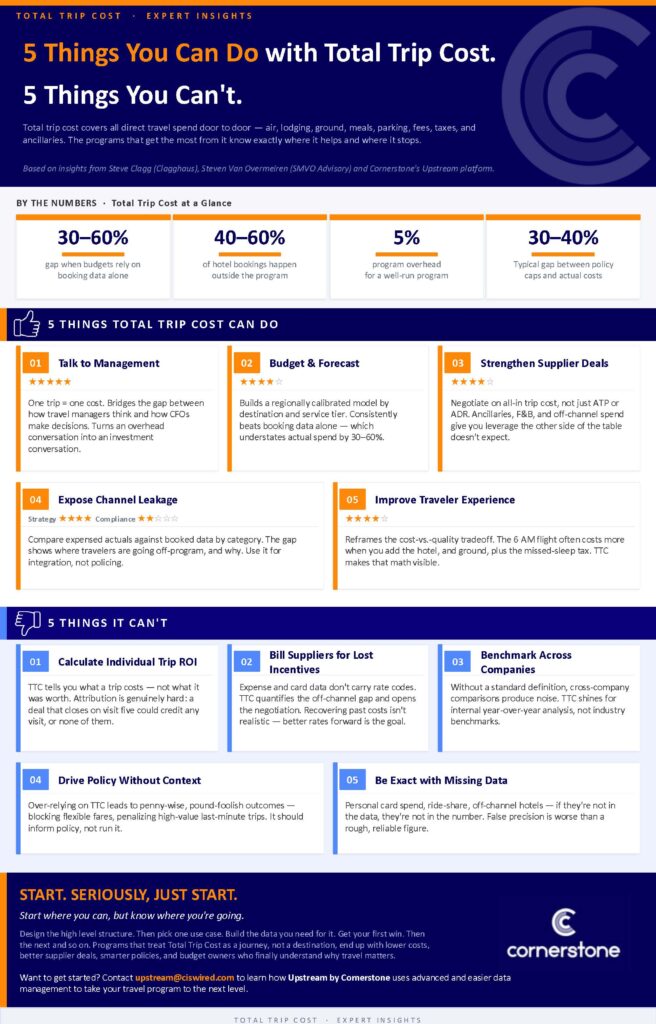
For example, a lower airfare may require an additional hotel night, lead to productivity losses due to poor flight timing, or increase transportation expenses.
Similarly, booking decisions that appear compliant at first glance may still introduce hidden costs once servicing, disruptions, or traveler inefficiencies are factored in.
This is why total trip cost analysis is becoming increasingly important.
Instead of evaluating spend line by line, organizations are starting to analyze travel holistically, helping teams better understand tradeoffs and make more informed decisions.
The Industry Is Moving Beyond Static Reporting
Another key takeaway was that traditional reporting methods are no longer enough.
Static reports delivered weeks after travel occurs make it difficult for organizations to respond quickly to changing costs, traveler behavior, or supplier trends.
Travel leaders are increasingly looking for:
- Near real-time visibility
- Unified reporting across systems
- Actionable insights instead of raw data
- Better benchmarking and forecasting capabilities
- More accurate forecasting for budgeting and negotiations
Modern data management and analytics platforms are helping organizations move from backward-looking reports to more proactive travel program management.
As expectations from finance and executive leadership continue to grow, travel managers are being asked to provide clearer, faster, and more defensible insights than ever before.
From Cost Tracking to Strategic Program Management
One of the clearest takeaways from the discussion was that total trip cost is not just another cost-cutting exercise.
It’s about creating a smarter, more strategic travel program.
Organizations that successfully adopt total trip cost analysis are using it to:
- Improve supplier negotiations
- Build more effective travel policies
- Reduce unnecessary friction for travelers
- Support budgeting and forecasting
- Improve visibility for finance and procurement teams
- Make more informed operational decisions
The discussion reinforced how much the role of the travel manager continues to evolve. Teams are being asked to think beyond bookings and policy enforcement and contribute more directly to broader business decisions.
And that shift starts with trusted data.
Watch the Full Webinar On Demand
If your organization is struggling to connect travel data, understand true trip costs, or provide finance teams with more actionable visibility, this conversation offers valuable insights from experienced industry leaders.
Watch the webinar to learn:
- What total trip cost actually includes
- Why disconnected data creates hidden costs
- How traveler behavior impacts program performance
- Ways to balance savings with traveler experience
- How modern analytics are changing travel program management
Featuring:
- Mitch Gross, Managing Director @ 12 Squared Growth
- Suzanne Boyan, Travel and Meetings Manager @ CES Associates
- Steven Van Overmeiren, Founder @ SMVO Advisory
Let’s Talk About Your Travel Data Strategy
If your organization is looking to unify travel and expense data, improve visibility into total trip costs, or strengthen decision-making across your travel program, Cornerstone can help.
Reach out at upstream@ciswired.com or visit www.ciswired.com/upstream to learn more.
We look forward to seeing you next time on The Corner.