
Corporate travel managers know how much their companies spend on travel. But explaining what the business gets in return is a different challenge.
Booking reports can show airfare costs, hotel rates, and policy compliance. Expense reports tell another part of the story. Finance leaders need to understand how those numbers affect budgets, where spending could be better managed, and whether the trips employees take are worth the cost.
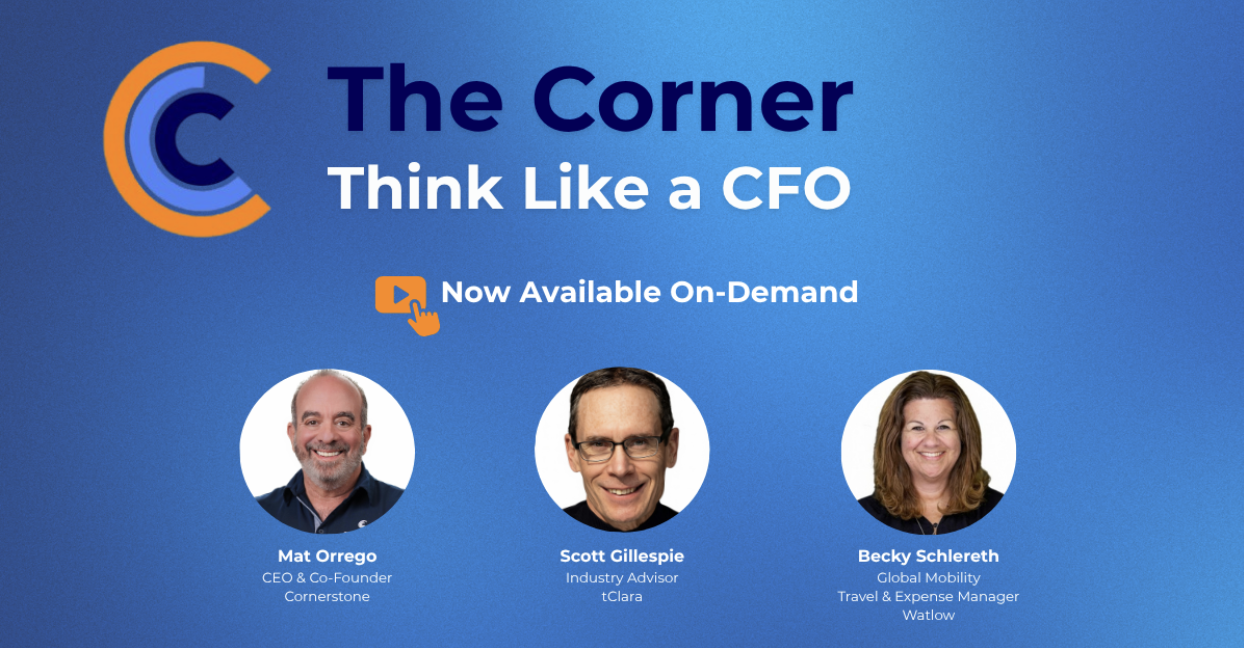
In our latest episode of The Corner, Think Like a CFO: Turn Travel Data Into Better Financial Decisions, Cornerstone CEO and Co-Founder Mat Orrego was joined by Becky Schlereth, who oversees global mobility, travel, card, and expense at Watlow, and Scott Gillespie, an industry advisor with tClara.
The panel discussed how travel managers can better explain the financial value of business travel, why forecasting remains difficult, and what CFOs need from travel reporting.
Here’s what they discussed.
How Do You Measure the ROI of Business Travel?
Companies can track the cost of nearly every business trip. Measuring the return on those trips is much harder.
Scott Gillespie challenged the traditional approach to travel reporting by asking how companies can evaluate their travel budgets without knowing what individual trips are worth.
He introduced a proposed method for estimating a trip’s return on investment (ROI) before it takes place.
It starts with a question: What’s the most this trip could cost and still be worth taking?
Scott used an example in which a trip has a maximum justifiable cost of $4,000. If the actual cost is $1,500, the difference is $2,500 in estimated value. Based on those assumptions, the trip would have an estimated ROI of approximately 167%.
He then suggested accounting for factors that could affect the trip’s success, using a scoring system to help companies compare travel requests.
Under this proposed approach, trips with higher estimated returns and lower risks could receive priority, while lower-value trips might require additional approval.
Scott acknowledged that this isn’t an established industry standard. It’s a method he believes companies should begin testing.
The discussion also raised questions about who should determine a trip’s value and how to prevent travelers from overestimating it.
Scott suggested having travelers provide an initial estimate, with managers reviewing or adjusting that number before approval.
Rather than making decisions based only on ticket prices or trip duration, the approach would encourage companies to consider why employees are traveling in the first place.
The Value of a Managed Travel Program
Measuring the return on an individual trip is one challenge. Showing the value of the travel program itself is another.
Becky Schlereth explained that travel managers often receive the most recognition for savings achieved through supplier negotiations, preferred vendor usage, and policy compliance.
Those results are relatively easy to document.
Other parts of a travel program, including traveler safety, productivity, and employee experience, are harder to measure.
At Watlow, employees travel for different reasons, including engineering, field service, and sales. Becky explained that the travel program needs to support those employees while keeping spending and policy requirements in mind.
She shared an example from a project in Mexico where employees had different expectations about recovery time after international travel.
Some European employees felt they needed two or three days before beginning meetings, while North American employees were generally comfortable starting the following day.
These differences can affect travel policies and employee productivity, even when the financial impact isn’t immediately clear.
Becky also noted that preferred supplier agreements may include benefits such as priority boarding or preferred seating. Those benefits can improve the travel experience without necessarily appearing as direct savings in a report.
Her point was that the value of a travel program goes beyond negotiated rates. Travel managers also help employees travel safely, follow company policy, and arrive ready to work.
Why Booking and Expense Data Need to Work Together
A major challenge for travel managers is understanding the difference between what employees book and what they actually spend.
Travel management company (TMC) reports provide valuable information about airfare, hotels, and rental cars. But booking data doesn’t include every cost associated with a trip.
Meals, ground transportation, ancillary fees, and other expenses may be recorded separately.
For travel managers who don’t oversee corporate cards or expense reporting, getting a complete picture can be difficult.
Becky shared an example of how easily this information can be misunderstood.
While preparing year-end reports, she presented TMC booking data alongside expense data to help leadership understand spending patterns and identify gaps.
Instead, the two datasets were combined in a way that counted some spending twice, making the company’s travel costs appear higher than they were.
The resulting analysis suggested that spending needed to be brought under control, even though that wasn’t the conclusion Becky intended to communicate.
Her experience showed why travel managers need to explain what each report includes, where the numbers overlap, and what leadership should take away from the information.
Mat Orrego also emphasized that finance teams need consistent numbers across booking, card, and expense systems.
When reports show conflicting totals without an explanation, it becomes harder for leadership to trust the information.
For travel managers without direct access to expense data, Becky recommended working more closely with the departments responsible for those systems.
Understanding the difference between booked and actual spending is an important part of explaining the true cost of business travel.
The Challenge of Forecasting Corporate Travel Spend
Forecasting was one of the biggest challenges Becky identified during the webinar.
Travel managers can monitor airfare trends, supplier negotiations, and changes in hotel rates. They can also review historical spending to estimate how costs may change.
What they often don’t know is how much employees will need to travel in the coming months.
A travel manager may not have visibility into which departments are planning additional trips, who will receive travel approval, or how business needs will change.
That makes it difficult to forecast spending accurately from one quarter to the next.
Becky explained that travel teams often rely on historical data and expected price changes because they don’t have access to every factor influencing future travel.
Mat also discussed the importance of identifying changes early enough for finance to respond.
For example, if hotel rates are expected to increase by 8%, simply reporting that increase isn’t enough.
Leadership may want to know how much the change could add to the travel budget, whether the company can offset some of the increase, and what the travel team recommends doing about it.
Becky noted that finance leaders also tend to focus on gaps. If a travel manager reports 85% policy compliance, the next question may be about the remaining 15%.
Travel managers need to understand those gaps and be prepared to explain what can be done about them.
What CFOs Actually Need From Travel Reporting
More data doesn’t necessarily mean better reporting.
Mat explained that finance leaders need information they can trust, delivered while there’s still time to make a decision.
A report showing that spending increased last month may explain what happened. But if the information arrives too late, there may be little opportunity to address the cause.
Scott encouraged travel managers to think about the three measures they would most want to present to their CFO on a regular basis.
He also stressed the importance of having a reliable benchmark.
For example, reporting an average ticket price is useful, but without a point of comparison, leadership may not know whether that number represents good performance.
Becky agreed that reports should be simple and specific.
Travel managers should be able to explain the information they’re presenting, answer questions about it, and recommend changes when necessary.
If employees aren’t using preferred suppliers, for example, the report should do more than identify the problem. It should help explain why it’s happening and whether a policy change might improve compliance.
The panel’s advice was to start with the question leadership needs answered, then provide the information necessary to answer it.
How Travel Managers Can Build Trust With Finance
Travel managers don’t always control travel budgets or determine which employees need to travel. But they have information that can help finance teams make better decisions.
They understand supplier relationships, booking behavior, policy requirements, and the challenges employees face when traveling.
That knowledge matters when interpreting spending reports.
Mat encouraged travel managers to connect their reporting to specific decisions rather than sending leadership a collection of numbers.
Scott suggested that companies interested in measuring trip ROI could begin with a single department or division instead of changing their entire travel program at once.
Becky emphasized the importance of using data that travel managers understand well enough to explain and defend.
The discussion made one distinction especially clear: The return on individual business trips and the value of managing a travel program are not the same thing.
Both matter when evaluating corporate travel spending.
For travel managers, thinking like a CFO means being able to explain not only what the company spent, but why it spent that money, what it received in return, and where improvements could be made.
Watch the Full Webinar on Demand
Want to hear the full discussion?
Watch this episode of The Corner featuring Mat Orrego, Becky Schlereth, and Scott Gillespie as they discuss:
- How companies could begin measuring business travel ROI
- Why the value of a travel program goes beyond cost savings
- The importance of connecting booking and expense data
- Challenges with corporate travel budgeting and forecasting
- How to make travel reporting more useful to finance leaders
Watch the Full Webinar on Demand
Let’s Talk About Your Travel Data
Travel reporting gets complicated when information is spread across multiple systems.
Cornerstone’s Upstream helps organizations bring travel data together so travel managers can review spending, track supplier performance, and better understand what’s happening across their programs.
Whether you’re preparing for budget discussions, reviewing program costs, or trying to get a more complete picture of travel spending, having reliable information makes a difference.
Visit ciswired.com to learn more about Upstream and Cornerstone’s travel data solutions.
We look forward to seeing you next time on The Corner.