
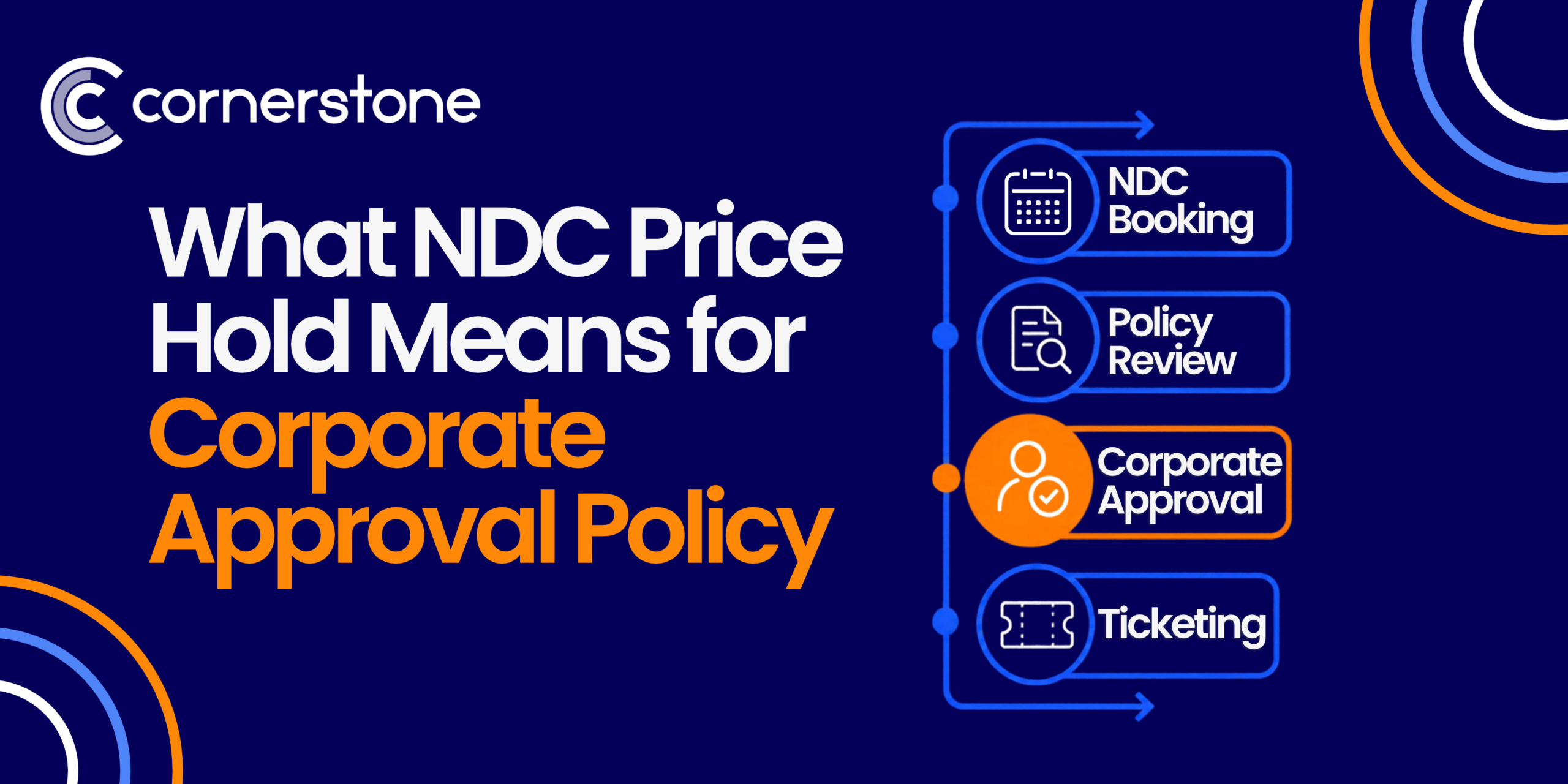
Lufthansa Group is now offering eligible corporate NDC bookings a price guarantee of up to 24 hours as part of a pilot that began Oct. 1.
As reported by Business Travel News (BTN), the airline group said the additional time is intended to accommodate corporate approval processes that do not always fit within standard booking windows. Eligible bookings must include a valid Corporate Location Identifier, and the pilot is scheduled to run through Jan. 18, 2027.
Lufthansa has said it will assess uptake, commercial performance and partner feedback before determining whether to extend or expand the offer.
NDC adoption has largely been discussed in terms of content, connectivity, servicing capability, and commercial strategy. Yet corporate booking still has to operate inside a travel program. A fare can be available through an NDC connection and still require policy review, management approval, traveler communication or intervention from the TMC before ticketing.
Lufthansa’s decision to provide additional time for some of those steps brings that operational layer into clearer view.
The booking may be new. The approval work is familiar.
Corporate approval processes are rarely uniform.
One client may require approval only when a trip exceeds a certain threshold. Another may route international travel to a different approver. A third may require exceptions to be reviewed by the travel team or procurement. Policy rules can also differ by business unit, traveler type, destination, fare class or supplier.
All of that existed before NDC.
The difference is that TMCs increasingly have to support those requirements across a wider range of booking and content environments.
Corporate air bookings can move through several paths, including online and agent-assisted channels, NDC-enabled connections and supplier-direct channels outside the traditional managed flow. What happens after booking depends on how those sources connect into the policy and record-processing workflow.
That creates more opportunity for gaps between content availability and the corporate controls surrounding the trip.
Lufthansa’s pilot addresses one specific pressure point by protecting an eligible NDC fare for up to 24 hours. That can give the traveler and company more time to complete an approval process before the fare changes.
The extra time is useful. It does not remove the need to manage the approval process well.
Where the agency work starts to accumulate
Policy and approval workflows can create a surprising amount of operational work when the process relies on manual intervention.
A booking falls outside policy. The traveler needs to understand what triggered the exception. An approver needs enough information to act. Someone may need to follow up if the request sits unanswered. The travel manager may want visibility. A risk provider or other stakeholder may also need to be notified.
If those steps are not automated, some of the work often lands with the TMC.
That may mean agents checking status, forwarding information, explaining exceptions or helping move the booking through an approval process that sits partly outside the reservation workflow.
The problem becomes more visible at scale.
A TMC supporting dozens or hundreds of corporate clients may be dealing with different policy rules, different approval structures and different technology environments at the same time. Even small amounts of manual work can add up quickly when they are repeated across a large booking population.
That is one reason policy management deserves more attention as distribution becomes more fragmented.
Client-specific rules are part of the business. The operational challenge is applying them without forcing agents or support teams to act as the policy and workflow engine.
Automating the steps around the exception
Cornerstone’s Policy Compliance Manager (PCM) is built around that part of the process.
PCM automatically applies configurable business rules, identifies policy exceptions, sends traveler notifications, routes bookings for approval and alerts other stakeholders when action is required. It also supports online booking tools along with GDS and non-GDS sources.
For a TMC, the practical value comes from reducing the number of repeatable tasks that require someone to intervene.
An agent may still need to work with a traveler when the situation is unusual, when a booking needs to be changed, or when the client wants advice. Those are service functions where human involvement makes sense.
Checking whether a booking meets a known rule is different. So is forwarding an approval request or reminding the right person that a decision is pending.
Different customers can retain their own policy rules, approval paths and audit requirements. Automation gives the TMC a consistent way to apply those requirements across booking sources, with timely ticketing alerts and an audit trail built into the process.
Where agents should spend their time
For TMCs, the question is also one of resource allocation. Agents are expensive resources, and their time is better spent resolving complex issues, advising clients and travelers, or handling situations where experience matters.
Policy administration can consume that time without adding much service value. The more booking environments a TMC supports, the harder it becomes to justify using human labor to connect workflows that technology can manage automatically.
Cadence Travel’s Jeff Jarvie described the effect this kind of automation can have on the agent role:
“Our agents can be travel consultants now, not machines matching tickets with people.”
- Jeff Jarvie, Cadence Travel
That distinction matters as TMCs try to maintain service quality while managing the cost and complexity of supporting increasingly varied booking environments. Policy checks, approval routing, and routine status communication are repeatable processes. Agent expertise is better reserved for the cases that actually require it.
Policy consistency across the distribution mix
Lufthansa also encouraged corporate customers to confirm that NDC is fully enabled for their bookings. For TMCs, the broader issue is how corporate policy and approval workflows operate across the different points of sale now in play.
The 24-hour hold recognizes a practical corporate constraint. NDC content still has to fit inside the customer’s approval process. Extending the price-guarantee window gives that process more room to operate without immediately sacrificing the quoted fare.
For TMCs, the challenge is applying each client’s policy and audit requirements across those different booking environments. A flexible policy workflow gives the agency a consistent way to handle approvals and exceptions as distribution changes.
Lufthansa’s hold gives eligible NDC bookings more time to clear approval. Automated policy review, routing and communication can make that window more useful without adding another layer of manual agency work.
That is the operational issue behind the announcement. As distribution options multiply, the policy workflow still has to work consistently for the corporate customer.
Learn how automated policy management fits into the modern travel workflow.