
Travel policies have always had a difficult job.
They need to control costs, give travelers clear guidance, support duty of care, and reflect how employees travel.
But what that looks like can vary significantly from one organization to another.
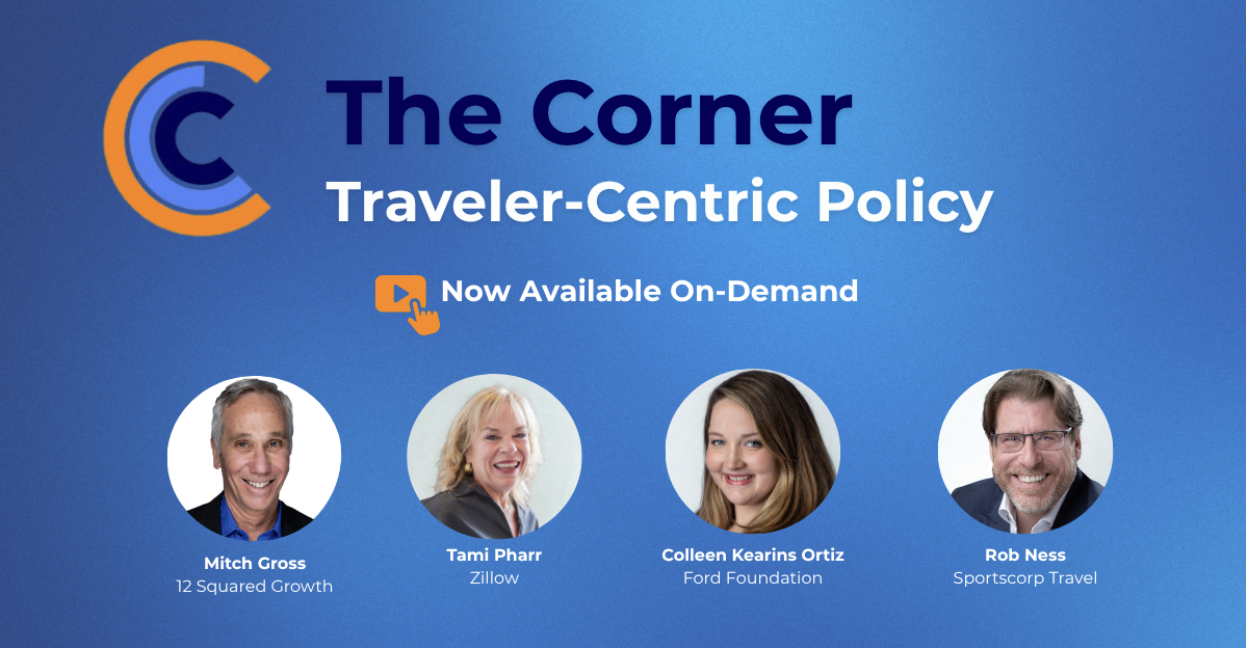
That was the focus of our recent The Corner webinar on travel policy, featuring Colleen Kearins Ortiz of the Ford Foundation, Tami Pharr of Zillow, Rob Ness of SportsCorp Travel, and moderator Mitch Gross.
The panel talked about how their organizations approach travel policy, where they are making changes, and how data and new technology are helping them evaluate what is and isn’t working.
Here are some of the highlights from the conversation.
There Isn’t One Right Way to Build a Travel Policy
A travel policy must work for the organization it serves.
For the Ford Foundation, that means putting a strong emphasis on compliance and duty of care. Employees regularly travel internationally, including to destinations where the organization needs to know where travelers are and how to support them.
Zillow has a different set of considerations. With employees spread across all 50 states, travel plays an important role in bringing people together. Tami shared that approximately 60% of Zillow’s travel spend is tied to internal meetings.
Those are two very different travel programs, so it makes sense that their policies don’t look the same.
Company culture, where employees travel, why they travel, and how much flexibility they need all effect what belongs in a policy.
A Policy Only Works if Travelers Can Use It
Travel policies tend to get long.
Every exception, requirement, approval process, and new scenario can add another section. Over time, a document that started as a straightforward set of guidelines can become difficult for employees to navigate.
Colleen shared that the Ford Foundation is working to reduce a roughly 36-page travel policy to fewer than 20 pages. Tami said Zillow’s combined travel, expense, and corporate card policy is more than 60 pages.
The problem isn’t necessarily that all of that information is unnecessary. The problem is expecting a traveler to search through dozens of pages every time they have a question.
That puts more emphasis on how employees access policy information, not just what is written in the document.
Cost Isn’t the Only Consideration
Keeping travel spend under control is always going to matter, but the lowest-cost option isn’t automatically the best choice.
At Zillow, for example, much of the company’s travel supports internal meetings. Those trips give a distributed workforce time to work together in person, build relationships, and plan.
That purpose matters when evaluating the cost of the trip.
The same is true when a cheaper flight adds hours to a traveler’s day, when a hotel creates an unnecessarily long commute, or when a restrictive policy pushes travelers to book somewhere else.
Travel teams still need to manage budgets. But they also must consider what employees need to accomplish during the trip and whether the policy helps or gets in the way.
Accessibility Needs to Be Part of the Policy
The panel also discussed reasonable accommodations and how they fit into travel policy.
Colleen talked about making sure employees have a clear process for requesting accommodations they may need while traveling.
Depending on the traveler, that could affect class of service or other parts of the trip.
Building those considerations into the policy gives employees a clearer path for requesting what they need and gives the travel team a consistent way to handle those requests.
Duty of Care Can Change the Rules
For organizations with significant international travel, knowing where employees are isn’t just helpful for reporting. It can be a safety issue.
That makes booking behavior especially important.
If an employee books outside approved channels, adds personal travel to a business trip, or changes an itinerary without the organization knowing, the company may have an incomplete picture of where that traveler is.
The panel’s discussion showed why policy decisions can’t be based on cost alone. Where employees travel and the organization’s responsibility for those travelers can affect how much flexibility a program can reasonably provide.
AI Is Giving Travel Teams Some New Options
The panel also shared a few ways they are already experimenting with AI.
Colleen discussed using approved tools to help simplify policy language, look at possible policy changes, and estimate what those changes could mean financially.
She also talked about making it easier for employees to get answers to basic policy questions without searching through the entire document.
Tami shared an example focused on out-of-policy bookings. Instead of simply notifying someone that a booking falls outside policy, her team has looked at ways technology could help identify the issue, find an alternative that meets policy, and give the traveler information they can use.
These are practical uses. They don’t replace the travel manager or make the policy decisions. They can make some of the work involved in managing and communicating policy easier.
There Still Needs to Be a Person Checking the Work
The panel was also clear that using AI doesn’t mean accepting every answer it gives you.
Information still needs to be reviewed and verified.
That’s especially important when you’re looking at the financial impact of a policy change or working with company and traveler information.
The same goes for which tools employees use. Companies may have specific requirements around approved AI tools and what information can be entered into them.
For travel teams, AI can help with some of the legwork. The travel manager still needs to understand the program well enough to know whether the answer makes sense.
Data Helps Take the Guesswork Out of Policy Changes
When it’s time to change a policy, travel teams need to know what travelers are actually doing.
Where are they consistently booking outside policy? Which suppliers are they using? Where is the company spending more than expected? What would happen if a fare or hotel threshold changed?
Answering those questions can be difficult when the information is spread across booking tools, expense systems, card programs, supplier reports, and other sources.
Once that information is brought together, travel managers can look at the actual behavior behind a policy issue.
Instead of assuming a rule is too restrictive, or a threshold is too low, they can see where the problems are happening and what a change could mean for the program.
Travel Policy Isn’t Something You Set and Forget
A policy that worked a few years ago may not make sense today.
Travel costs change. Companies change. Employees work differently. New technology creates new questions and new options.
That doesn’t mean rewriting the policy every few months. It means checking whether the rules still make sense for the way employees are traveling.
The panel showed just how different that process can look from one company to another.
There isn’t a perfect number of pages, a perfect compliance rate, or a single approach every company should follow.
The goal is much simpler: create a policy that works for the business and the people traveling for it.
Watch the Full Webinar on Demand
The panel covers:
- How different organizations approach travel policy
- Where flexibility makes sense and where stricter rules may be necessary
- Balancing travel costs with the employee experience
- Accessibility and reasonable accommodations
- Duty of care and international travel
- How travel teams are using AI today
- Using program data to evaluate policy changes
Featuring:
- Colleen Kearins Ortiz, Senior Manager, International Operations & Travel, Ford Foundation
- Tami Pharr, Senior Corporate Travel Program Manager, Zillow
- Rob Ness, Director of Client Management & Business Intelligence, SportsCorp Travel
- Mitch Gross, Moderator
Let’s Talk About Your Travel Data
Making better policy decisions starts with understanding what’s actually happening across your travel program.
Upstream brings travel and expense data together so teams can get a clearer view of spend, supplier performance, traveler behavior, and policy compliance without piecing together information from multiple systems.
Reach out at upstream@ciswired.com or visit www.ciswired.com/upstream to learn more.
We look forward to seeing you next time on The Corner.